Hello, everyone! I'd like to welcome everyone (or welcome you back, whichever the case may be) to The Main Street Newsstand, formerly known as Disney Theme Park Book Reviews.
A long time ago in what seems like a galaxy far, far away, I posted reviews of current and out-of-print books having to do with the Disney theme parks. I stopped updating the blog more than two years ago because life got in the way and something had to give. Since then, my life's gone through a few more changes, and I discovered that I've really missed writing just for the fun of writing, so I'm blowin' the dust off of this ol' blog and getting things going again.
Although my focus will still primarily be reviewing books about the Disney parks - and trust me, I've got a lot of books on my bookshelf that I can review! - I'm expanding the scope fo the blog a little bit so that I can comment on some of the interesting, frustrating, and just plain odd things that I see the Walt Disney Company doing as they run and promote their theme parks and resorts. I'm hoping that by expanding the focus a bit, I can provide content a little more regularly; one of the big challenges of writing reviews is that I insist on reading or re-reading the books I review, and sometimes all my commmitments don't always give me a chance to bet as caught up on my reading. Fortunately, expressing whatever opinions I have doesn't require a lot of prep time!
I don't know for sure how long I'll keep the Main Street Newsstand open and how often a new item will be on display, but whatever happens, it'll be fun. I hope you'll join me as I embark on a new adventure!
Tuesday, January 17, 2012


Saturday, December 19, 2009
The Biggest WDW Guidebook Of Them All

The Unofficial Guide to Walt Disney World 2010, by Bob Sehlinger with Len Testa. Hoboken, NJ: John Wiley and Sons, 2009, 850 pp.
As you folks who read this blog regularly know, I love to read a good guidebook about a Disney theme park. Not only can they be helpful in making the most of a visit to a park you're not familiar with, they serve as a snapshot of what a particular park was like at a certain time; if I ever need to settle a bet about whether or not an attraction was open or not in a certain year, I almost always turn to my collection of guidebooks. I figured it was about time that I turn my attention to one of the biggest (in terms of popularity and in terms of size) out there, so this time we'll be reviewing the grandaddy of all Walt Disney World guidebooks.
The Unofficial Guide to Walt Disney World has got to be one of the most comprehensive guides to planning and enjoying a Walt Disney World vacation. From providing resources and suggestions for planning a trip to central Florida to in-depth discussions of lodging, food and entertainment options, as well as a comprehensive guide to all of the Disney theme parks and a couple of the non-Disney parks, the Unofficial Guide just about has it all; if there's something you need to know about Walt Disney World that isn't in this book, I haven't found it yet. Unlike most guidebooks, the Unofficial Guide's advice isn't solely based on the knowledge of a well-traveled author (although Bob Sehlinger and Len Testa certainly have lots of experience traveling to WDW); the book also depends heavily on the opinions of its readers to provide judgements on attractions and restaurants and on computer algorithms to determine the best plans for touring the parks. Also unlike some guides, the Unofficial Guide is opinionated - not just about whether an attraction, hotel, or restaurant is good or bad, but also about some of Disney's policies and business decisions, but the opinions are based on a love of and respect for the product.
As you may have guessed by that lengthy synopsis (well, hey, it's a lengthy book!), I really enjoy reading and using the Unofficial Guide to Walt Disney World. It's a great source of information on what's new and what's changed (for better or for worse) at the Disney theme parks, and it's a great read to boot. Bob and Len provide a lot of useful stuff in this book, whether it's your first trip or your 51st, and they provide it in a witty and opinionated style that prevents all the knowledge being provided to you from being overwhelming. Bob and Len aren't afraid to bite the gloved hand that feeds them, but you never get the impression that it's meant out of spite or solely to stir up controversy.
So who's not going to like this book? Well, first and foremost, if you're one of those people who prefers to see the (Walt Disney) World through Mouse-colored glasses, this probably isn't the book for you; Bob and Len aren't afraid to criticize Disney if it's warranted, but there'll always be people who think that Disney can do no wrong, and they won't be happy to be told otherwise.
I know some folks are going to be intimidated by the sheer size of this book. (An important note: Don't drop this book in the vicinity of your foot or any small children or pets - you'll probably do some damage.) The Unofficial Guide probably isn't the book to pick up in the airport newsstand while you're waiting for your flight to Orlando, because it's going to require you to invest a little of your time; it's better to invest a little of your time before you go than to invest a lot more time and money when you get there because you didn't pick up some important advice. (If the size of the book really is a problem, look for the Unofficial Guide to Walt Disney World Mini-Mickey, which is a condensed version of the regular Unofficial Guide.)One other minor quibble I have with the guide: Does it have to have so much of the illustrations and text in blue? There's nothing wrong with blue, you understand, it just gets overwhelming after a while, particularly if you're crazy like me and read it from cover to cover. Aside from that, no worries.
The Unofficial Guide to Walt Disney World 2010 is a comprehensive, informative,and well-written guide to planning, enjoying, and saving time and money on a Walt Disney World vacation. The book will require a little more time to read and review because of its size, but it's time well-spent; readers who prefer their Disney guidebooks with a little less opinion or heft and a bit more pixie dust may want to consider another guidebook, such as the Birnbaum Walt Disney World or the PassPorter Walt Disney World guidebooks. The book can readily be found at most major chain and online bookstores, as well as independent bookstores with a good selection of travel books.
Oh, and one last thing: Happy holidays, everyone! Thanks for reading, and I promise lots more fun and interesting reviews in 2010.
Sunday, November 29, 2009
A Challenge From The Mouse

Disneyland Challenge, by Jim Fanning; Jody Revenson , senior editor. New York: Disney Editions/D23, 2009, 128 pp.
There are few things that I enjoy more than a book that tests my knowledge of the Disney theme parks. It's not that I think I know everything there is to know about the parks, you understand; I've learned a lot about the Disney parks over the years, but I realize that there's always going to be more for me to discover. But it's kinda fun to see how much I do know, and when I get a few (or more than a few) questions wrong, at least I know that I've picked up some more interesting bits of information about the parks. Apparently I'm not the only one who enjoys getting quizzed on how much I know about the Disney theme parks, because Disney recently released a new book that promises to "put (readers') Disneyland Resort knowledge to the test". For my latest review, I'm going to take up the Disneyland Challenge and see if the book lives up to the promises it makes on the cover.
Disneyland Challenge is one of several books about the Disney theme parks recently released by Disney under the D23 label; the book is intended to test readers' knowledge of and provide readers information about the lands and attractions of Disneyland, Disney's California Adventure, and the Downtown Disney district. The first thing you'll notice about the book is that it's been designed to be brought along with you as you visit and perhaps take a little punishment in the process; it has a multi-ring binder holding it together instead of traditional binding and the paper's thicker and glossier than the paper most guidebooks are made of. Disneyland Challenge is also formatted differently than most books about the parks; the book contains lots of images, and most of the text is in small multicolored boxes, with each box's color indicating a different category of information. To use the book, just flip through it until you find the page about the attraction or land you're visiting, and then start working on the challenges or start reading about some of the things you'll find there. To solve the challenges, look around and do your best to notice the little things all around you, because the answers to many of the challenges will often be in plain sight.
I have to give the folks who put Disneyland Challenge together points for really thinking outside the box - the format of this book's unlike any quiz book or guidebook about the Disney theme parks I've ever seen. I like the fact that this book encourages readers to bring the book along with them as they visit the theme parks and to pay attention to the little details that add to the overall experience - any book that encourages park guests to slow down a little and appreciate the full Disney experience is a good thing as far as I'm concerned. There's some interesting information in Disneyland Challenge; I think most Disneyland fans will learn at least a couple things they didn't know by reading this book, and more casual Disney fans might be encouraged by the discoveries they make while using this book to learn more about Disney history and to try and discover more Disney details.
Unfortunately, the unusual format of Disneyland Challenge is as much a drawback as it is something that sets the book apart. The book tries so hard to be visually exciting, with lots of images and comic book inspired title and text fonts, that the information being provided seems to get lost in the shuffle. Flipping through the book to find an attraction is an interesting idea, but the book should have still included an index and numbered pages for the benefit of people who prefer to find something the traditional way. This book's really intended more for casual fans of the parks or folks who have just started discovering the history and details of the Disneyland Resort. Readers who are more familiar with the Resort aren't going to find the challenges all that challenging, whether they're in the Park when they read this book or not. Lastly, I'm really surprised that a book put out by Disney about two of its theme parks is so out of date; there are quite a few pages and more than a few photos in this book that reference attractions that no longer exist or that have been significantly changed. I realize that the Disney theme parks are in a constant state of change and no book about the parks will be 100% accurate, but the format of the book makes the mistakes more obvious.
Disneyland Challenge is a different take on the Disney theme park trivia book; its unusual format and reliance on images and brief bits of information and trivia make it an interesting way to enhance the Disney experience for the casual visitor, but the easy questions will frustrate the seasoned Disney park fan looking to test and expand their knowledge of the California Disney parks. If you're a more devoted fan, I'd recommend Kevin Yee's Magic Quizdom for some challenging Disneyland trivia questions, or try Lou Mongello's Walt Disney World Trivia Book series if you want to test your knowledge of the Florida theme parks. Disneyland Challenge is currently being sold at the Disneyland Resort or through Disneyland DelivEARS, but it may also be available online through third-party booksellers at a substantial markup from the cover price.
Tuesday, September 29, 2009
An Artful Duo
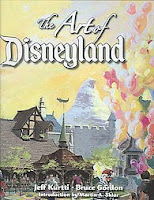
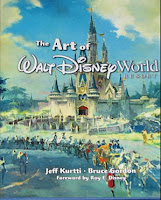
The Art of Disneyland and The Art of Walt Disney World, by Jeff Kurtti and Bruce Gordon. New York: Disney Editions, 2005; 131 pp. (Art of Disneyland)/2009; 139 pp. (Art of Walt Disney World).
Before we get started, I'd like to apologize to the folks who read this blog regularly for my extended absence. I wasn't planning to be away from here for so long, but some major speedbumps in my life got in the way. I'm not sure they're completely gone, but I enjoy bringing these reviews to you so much that I couldn't let this blog die. I hope you'll forgive me. Okay, so much for the mea culpas - on to the review...
Every theme park attraction begins as an idea. Long before the ideas become reality in the Disney theme parks, some very talented people use their skills as artists to give others a feel for what those ideas will look like when they reach fruition. It's safe to say that many of our favorite attractions - in some cases, our favorite theme parks - might have never become reality without the drawings and paintings these people created. Unfortunately, we seldom get to see these beautiful pieces of concept art created for the Disney parks, which is a shame; not only do we miss out on seeing some significant pieces of Disney history, we miss out on the chance to enjoy some beautiful art. The books we're going to look at today give us a chance to enjoy and appreciate some of this artwork.
The Art of Disneyland and The Art of Walt Disney World are two coffee table books that show us a few of the many pieces of concept art created by artists at Walt Disney Imagineering to inspire fellow Imagineers to create attractions or to inspire the public to visit those attractions. Some of the artists whose works are featured in these books - such as John Hench, Marc Davis, Mary Blair, and Sam McKim - will be very familiar to Disney theme park fans, as will some of the images, but there are many more drawings and paintings done by less famous names that are also featured.
You'll see art for world-famous attractions like Pirates of the Caribbean and The Haunted Mansion and lesser known-attractions such as the Snow White Grotto at Disneyland, as well as concept art for attractions that were never built; you'll also get a look at Disney artists' visions of lands in the theme parks from several different periods in the parks' history, as well as see art for attractions that have long since disappeared from Anaheim and Orlando.
The Art of Disneyland organizes the artwork by the lands the attractions were built in or were intended to be built in; The Art of Walt Disney World organizes the artwork by themes, such as nostalgia, adventure, and fantasy. Both books feature biographies of some of the artists whose art is featured in each book and a little bit of text providing some background on the lands or the categories by which the books are organized. Most of the artwork is printed sideways, allowing the art to be presented in a large enough size for the reader to fully appreciate it, but small enough for the art to fit onto a single page.
I enjoyed both of these books from the minute I opened the cover, and the last thing I wanted to do was to put either book down. The artwork is beautiful and is well reproduced, and there's a nice variety of artwork; unless you have friends who have taken you through the archives at Imagineering, I guarantee you that there will be art in each of these books that you've never seen before.
Jeff Kurtti and the late Bruce Gordon took a lot of care in choosing the art featured in these books, and it shows; in addition to including some of the drawings and paintings of the parks that are so iconic that you'd expect them to be in books like these, they included a nice selection of more obscure but equally beautiful work. For example, I'm a big fan of attraction posters, so I really enjoyed that The Art of Walt Disney World featured mini attraction posters created especially for the Main Street vehicles in the Magic Kingdom. Once you get used to holding the books on their sides, you learn to appreciate the decision of Jeff and Bruce to print the artwork sideways - in addition to enabling them to reproduce much of the art large enough to really take in the details, you avoid having to struggle to try and appreciate the art while a crease runs right through the middle of it.
Both The Art of Disneyland and The Art of Walt Disney World are amazing, but they're not perfect by any means. The biggest issue any Disney fan's going to have with these books is what you'll be paying for what you get; to put it bluntly, these books ain't cheap. The Art of Disneyland originally sold at the theme parks for $75.00, but is now available for a still pretty expensive suggested retail price of $49.95; The Art of Walt Disney World is available for $49.95 as well. That's a pretty steep price for books that are about 130 pages in length! As much as I'd love to buy multiple copies of these books and take them apart so I could frame and hang pages from them on my wall, I won't be doing it when these books cost that much. I wish both books had included some additional material, especially The Art of Walt Disney World; considering how much has been built at the World, I can't help but think that limiting the book to 130 or so pages meant that some really nice artwork was left out. (Well, I guess I can hope for a sequel to each of these books...)
The Art of Disneyland and The Art of Walt Disney World offer a fascinating glimpse into the archives of Walt Disney Imagineering, featuring some of the beautiful art created for the American Disney theme parks. While the books are a little thin and more than a little expensive, these books are a "must have" for any fan of the Disney parks. The Art of Disneyland is available through major retail booksellers like Amazon.com, as well as stores that carry a good selection of Disney literature, such as Compass Books at Disneyland's Downtown Disney district. (Please note that, aside from different art on the book jacket and some minor corrections, the current edition of The Art of Disneyland has the same content as the edition previously sold exclusively at the Disney theme parks.) The Art of Walt Disney World is currently available only at the Disney theme parks, although it can be purchased (at much higher prices than suggested retail) through the secondary market.
Wednesday, July 8, 2009
Bonjour, Mickey!

The Unofficial Guide to Disneyland Paris, 2nd Edition, by Bob Sehlinger. New York: Hungry Minds, Inc. (Wiley and Sons), 2001, 229 pp.
The birthday of The Happiest Place on Earth is almost here, so I think it's about time that I review another book about... Disneyland Paris. (Sorry, folks - when you engage in the "eeny meeny miney moe" method of pulling a book from the bookshelf, you never know what you're going to get.) Although I enjoy reading and doing reviews of just about any guidebook to the Disney theme parks, I especially enjoy finding and reading guidebooks about the overseas parks, because there just aren't that many books out there to help the armchair traveler/Disney fanatic to experience or plan for visiting those parks. Let's face it - if you want a book to plan for your trip to Disneyland or Walt Disney World, even the smallest bookshop will have something available for you to browse and buy. But if you'd like to visit one of the parks in Paris, Hong Kong, or Tokyo, lotsa luck. Today, we'll be looking at an older book that provides tips on visiting Disney's first European theme park that carries the name of a well-regarded series of guides to Disney theme parks and other vacation spots. But does this book live up to the Unofficial Guide name? We'll see...
The Unofficial Guide to Disneyland Paris was the second attempt by Bob Sehlinger, the author of The Unofficial Guide to Disneyland and The Unofficial Guide to Walt Disney World, to offer a guide to one of Disney's overseas parks (the first attempt was The Unofficial Guide to Euro Disneyland, published in 1993). The book provides helpful information on planning a trip to France to visit Mickey and his pals, including the best times of the year and the week to go, the various ways of getting to Disneyland Resort Paris, how to get to and from the resort to the City of Light, hotel options, attractions, and dining options. While the book's nowhere near as hefty as its more famous cousin The Unofficial Guide to Walt Disney World (which I'm convinced could kill small animals if dropped carelessly), it's got a lot of useful information, all presented in that famous unbiased and slightly snarky Unofficial Guide style. The book even has a brief but concise writeup on the history of Disneyland Paris and French attitudes toward the park, which is one of the better articles I've seen on the subject.
I'm a big fan of the Unofficial Guides (as can be ascertained by the fact that I have quite a large collection of them!), and I'm glad to say that Bob Sehlinger and his team did a very good job with this book. The book provides a lot of good information and helpful tips for enjoying your Disneyland Paris vacation, including a few touring plans for the park. The book provides some good information about hotel and dining options in the villages surrounding the Disneyland Paris Resort, which I think is a nice touch (it's always good when guidebooks to Disney parks recognize that there are plenty of good options outside of Disney property). The book is a fun and easy read, and should feel familiar to the folks who have read the Unofficial Guides to the U.S. parks (maybe a little too familiar, but more on that in a moment).
The Unofficial Guide to Disneyland Paris does have a couple of problems. The biggest one is that the book hasn't been updated or reprinted since 2001, which means that you may want to verify any information in the book, especially as far as lodging and dining options, before you use it to plan your vacation. (I've heard that a new Unofficial Guide to Disneyland Paris may be in the works, and I certainly hope that's the case). While Bob provides a lot of unique information in this book, fans of the series will recognize passages that were cribbed from the U.S. park editions of the Unofficial Guide. That doesn't make the advice in these passages invalid - certainly the Disneyland and Walt Disney World editions share a fair amount of information - but it's an unwelcome distraction.
Unlike the Unofficial Guides to the U.S. parks, the Unofficial Guide to Disneyland Paris is relatively light on park maps - even for touring plans. That's disappointing, because the maps in the Unofficial Guides are among the better maps of the Disney parks that I've seen. My last quibble with the book is about something it has that the other books in the series don't have anymore - a brief guide to the attractions that are unique to the park. This is a really cool thing to include, and it'd be great to have something like this available again in all the Unofficial Guides, if only just to have something to show non-Disney fans that if you've seen one park, you have not in fact seen them all (Jay Rasulo's attempts to attempt to homogenize them notwithstanding).
The Unofficial Guide to Disneyland Paris is an informative, helpful, and opinionated guide to the Magic Kingdom in France. While it does take some information from guides in the series to the U.S. parks and is in desperate need of a new edition, it can still provide a Disney fan heading for Europe some good advice and suggestions for making the trip a little less expensive and stressful and a lot more fun. The book can be very tricky to find nowadays - it'll occasionally pop up in used bookstores or some of the online sites specializing in older and out-of-print books.
Wednesday, June 17, 2009
Not the Britannica for Disneyland, But A Nice Reference

The Disneyland Encyclopedia: The Unofficial, Unauthorized, and Unprecedented History of Every Land, Attraction, Restaurant, Shop, and Event in the Original Magic Kingdom, by Chris Strodder. Santa Monica, CA; Santa Monica Press, 2008, 467 pp.
One of the questions I get about this blog (besides "Why don't you post more often?") is "Do you actually read all the books you review?" I do indeed, cover to cover, even if I've read them before - which can sometimes be a neat trick with all the demands for my time. I can now say, however, that I actually found time to read an encyclopedia! But is it worth your time to read and refer to it? Well, hopefully you'll have your answer after this review.
The Disneyland Encyclopedia attempts to provide all the information that a Disneyland fan might need to settle an argument or refresh his or her memory. The book provides entries for the lands, major and minor attractions, shops, restaurants, events, key people involved, and important elements of Walt Disney's original theme park, and covers everything from the Park's groundbreaking to recent times. Obviously, the book doesn't cover everything about Disneyland - a book that did so thoroughly would be a lot larger than almost 500 pages - but it attempts to cover as much as possible given the constraints of a reasonably priced one-volume set. The book gives readers several ways to access information - by alphabetical listing, by index, by citations of other entries, and (most interestingly) by a set of maps of the Park with each location noted with a letter and number code. The book also contains numerous lists about things found (or previously found) in the Park, a decent bibliography, and listing of relevant websites where readers can find additional information.
This book was a labor of love for its author, Chris Strodder, and it shows. Chris writes the book's entries in an entertaining and very accessible style; for the most part, he avoids being overwhelmingly positive or overwhelmingly cynical when writing about various elements of Disneyland, but he also manages to avoid being overly dry and refrains from being so obsessed with the minutiae of the Park that he runs the risk of boring or alienating his readers. The book is nicely illustrated with photographs from Disneyland (all in black and white, unfortunately); I particularly liked his use of photographs of windows on Main Street to illustrate his entries about Disney Legends involved in the creation of the Park and its attractions.
While overall I enjoyed The Disneyland Encyclopedia, I do have a few quibbles with the book. As you might expect with any project of this depth and breadth, there are a few errors - most of them about places and things outside of Disneyland, but I noticed that there seemed to be more mistakes about the Park near the end of the book than at the beginning (Chris was starting to run out of steam, perhaps?). Chris did a pretty good job with his research, considering he didn't use a lot of primary sources (it seems like his most of his primary source materials were old soft-cover souvenir guidebooks), but I wish that he'd taken the extra time to resolve some questions that his reference materials either didn't have answers for or had contradictory answers for. And, of course, The Disneyland Encyclopedia isn't a complete encyclopedia, by any means; there are a lot of things about the Park that aren't covered in the book or that I found myself wishing had been covered more thoroughly. That said, the book should provide the answers for most general queries fans have about the Park - and should even provide some new information for the Disneyland fan who thinks he or she knows everything.
The Disneyland Encyclopedia is an interesting and fact filled reference book about Disney's first Magic Kingdom. While it does contain a few errors and isn't an all-encompassing guide to the Park, it should be a handy reference for Disney theme park fans looking for quick answers to questions they may have while pursuing their interests. The book is sure to be a welcome addition to any Disney fan's bookshelf. The book is readily available through numerous sources online and in many brick and mortar bookstores that carry a selection of books about Disney.
Monday, May 4, 2009
A Book For Learning the Whys of WDW

The Unofficial Disney Companion: The Inside Story of Walt Disney World and the Man Behind the Mouse, by Eve Zibart. New York: Macmillan Travel, 1997; 213 pp.
If you've spent any time in your local bookstore's travel section, you know that there are a lot of books that give tips on how to enjoy the Disney theme parks. A little less often, you'll run into a book that tries to do something different - that is, a book that attempts to explain the "whys" of Disney instead of the "hows". Instead of providing advice on how to see the most things in the least amount of time and for the least amount of money, these books tackle subjects like how Walt Disney influenced the design and operation of the Disney theme parks, or what the thousands of Disney cast members do backstage magic that creates the magic onstage. These books can be absolutely fascinating, but they can also be frustrating and difficult to understand - calling a couple of them "dense" would be a major understatement. Today, we're going to discuss a book that tries to tell the inside story of Walt Disney World in a way that the average park visitor can appreciate.
As you may have guessed from its title, The Unofficial Disney Companion was intended as a companion piece to The Unofficial Guide to Walt Disney World. The book covers a lot of interesting aspects of the Walt Disney World story that tend to be given short shrift or get compeltely left out of the guidebooks, like why Walt wanted such a large parcel of land to build his Florida theme park, the challenges faced in making Walt's dream a reality, the times and trends that influenced Walt when he and the Imagineers created Disneyland and the Magic Kingdom, and how Michael Eisner influenced the expansion of the resort and the types of new attractions added to the parks during his tenure. Readers get a peek at what happens behind the facades and under the feet of the guests, get an idea of how sometimes Disney's view of American history may be a distorted one, and the challenges of dealing with animals and nature while trying to run one of the busiest tourist destinations in the world.
Eve Zibart does a really good job in this book of making topics that are normally the realm or academics and philosophers accessible to the layperson. Although by necessity Eve has to boil down some pretty complicated concepts into simpler ideas, she does so without making the reader feel like he or she's not getting the whole story. While Eve's obviously a fan of Disney in general and Walt Disney Worldin particular, she doesn't pull any punches when it comes to discussing what Disney does well and where Disney comes up short. This book's a fascinating look at some issues and ideas that the average visitor to the World might not generally consider, yet have a tremendous impact on what they experience.
That isn't to say that The Unofficial Disney Companion doesn't have its share of problems. Considering the amount of research that had to have gone into writing this book, Eve still manages to present some information that anyone who's done a little in-depth research on Walt Disney World knows is absolutely false (Cinderella Castle's tallest spire doesn't screw off in case of hurricanes, and the meteor projection in Space Mountain isn't a chocolate-chip cookie, just to cite two examples). Another really unfortunate oversight in this book is the lack of a bibliography, which means that readers can't go look for other books and articles that provide more information on topics that Eve covers in her book. Finally, a good portion of the information in Eve's book is now out of date; there have been a lot of changes at Disney since this book was first published more than 10 years ago (such as the addition of Disney's Animal Kingdom and the closing of the Disney Institute and Pleasure Island), and a new edition of the book hasn't been printed for several years.
It goes without saying that if you're one of those people that absolutely don't "want the magic spoiled" foe you about the Disney theme parks, The Unofficial Disney Companion isn't the book for you; if you're already a devoted fan of the Disney theme parks and are searching for more information about what goes on behind the scenes at WDW and why, you're probably not going to find anything in this boook that you haven't read somewhere else. But if you're one of those people that want to take their knowledge of Disney beyond what you've been told on an official Disney tour, this book might be a good start for your journey of discovery.
The Unofficial Disney Companion provides a fascinating look at what went into creating Walt Disney World as we know it today, including its history, the historical and cultural influences of its creator and his antecedents, and the challenges the Company and its cast members face in creating Disney theme park magic. The book's credibility is slightly hurt by including some old stories that have been proven to be false, but for the most part it's a good introduction to some aspects of the resort that many guests may have never considered.
The Unofficial Disney Companion has been out of print for several years, but it often turns up in used bookstores and on eBay. There's also a second edition of the book available; renamed Inside Disney, the second edition was published by Wiley in 2002. Aside from a few updates, both editions of the book are nearly identical.
Subscribe to:
Posts (Atom)